6 Hidden Problems with Conventional Water Dispensers — and How One Commercial 4-in-1 System Solves Them All
Table of Contents
- Introduction
- 1. Fragmented Functions: One Appliance, One Job
- 2. Space Takeover: When the Counter Becomes an Equipment Storage Area
- 3. Supply Interruptions: Running Out at Exactly the Wrong Time
- 4. Hidden Labor: When the Admin Team Ends Up Managing the Breakroom
- 5. Inconsistent Results: When the Same Drink Tastes Different Every Time
- 6. Energy Waste: The Hidden Cost of Running Multiple Appliances
- 7. Rethinking Commercial Drinking Water
- Conclusion: From Solving Problems to Eliminating Them
Introduction
Why fragmented drinking-water setups create more complexity — and how an integrated commercial system can simplify space, service, consistency, and energy management.
Your office or business may already have a water dispenser, refrigerator, ice maker, kettle, and countertop sparkling water machine.
Each appliance solves one problem. But together, they can create a whole new set of problems.
From wasted counter space and inconsistent water quality to frequent refilling, maintenance, and energy consumption, the true cost of a fragmented drinking water setup often goes unnoticed.
So what happens when four types of drinking water can come from one commercial system?
1. Fragmented Functions: One Appliance, One Job
A typical scenario
It’s 9:00 a.m.
Employee A wants hot water for tea, but the water dispenser is reheating. Another three-minute wait.
Employee B wants chilled water, only to find that the bottled water is gone and there’s no ice left.
Employee C heads to the countertop sparkling water machine — and discovers that the CO₂ cylinder is empty.
More appliances often mean more waiting, more things to check, and more chances for something to run out.
The real problem
Traditional drinking water equipment is usually designed around a single function. That makes it difficult to meet different drinking preferences instantly, especially during periods of high demand.
How a commercial 4-in-1 system solves it
Take Bestware's commercial 4-in-1 drinking water system as an example: one integrated system delivers four water options - hot, chilled, sparkling, and ambient.
Four independent water lines help keep each water type separate and operating without interference.
Hot water is adjustable from 45–98°C, while chilled water can be set anywhere from 0–8°C. Sparkling water is dispensed at approximately 3.0 volumes of CO₂, while ambient water is available instantly for everyday drinking.
The system provides up to 40 L/h of chilled or sparkling water and 20 L/h of hot water, helping maintain a steady supply during peak periods.
With dispensing taking as little as around 10 seconds per serving, waiting time is significantly reduced. The system can also be paired with a large-capacity CO2 cylinder, extending replacement intervals compared with the small cylinders commonly used in countertop sparkling water machines.
2. Space Takeover: When the Counter Becomes an Equipment Storage Area
A typical scenario
Walk into a small office pantry and you may find a water dispenser in one corner, a refrigerator in another, an ice maker squeezed into the remaining space, and a household sparkling water machine sitting in the middle of the counter.
Then come the bottled water, spare CO₂ cylinders, and other supplies.
Before long, a space designed for coffee breaks and conversation starts to look more like an equipment room.
The real problem
Every appliance needs its own footprint.
When several independent systems are combined, valuable counter and floor space disappears quickly.
How a commercial 4-in-1 system solves it
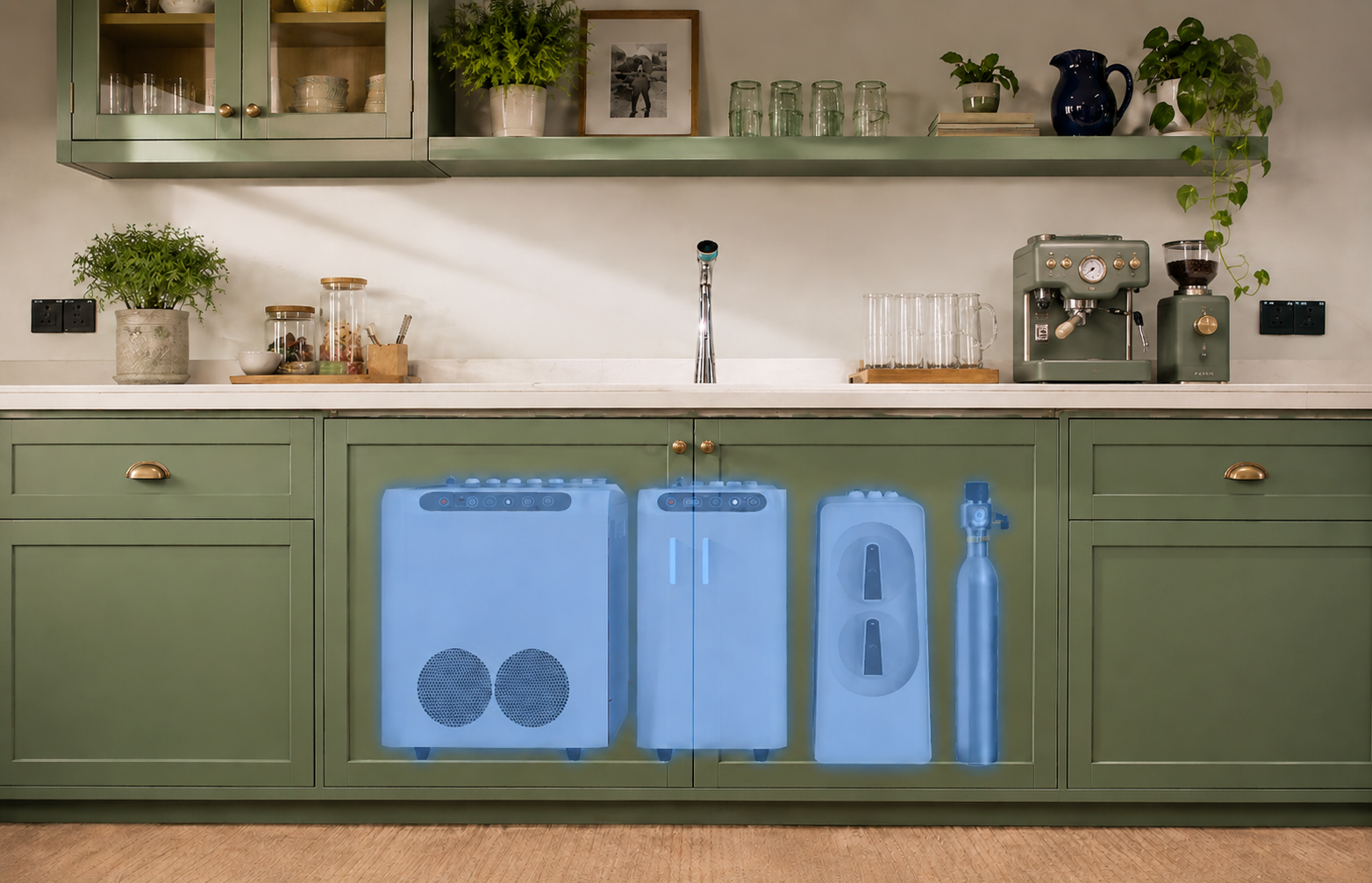
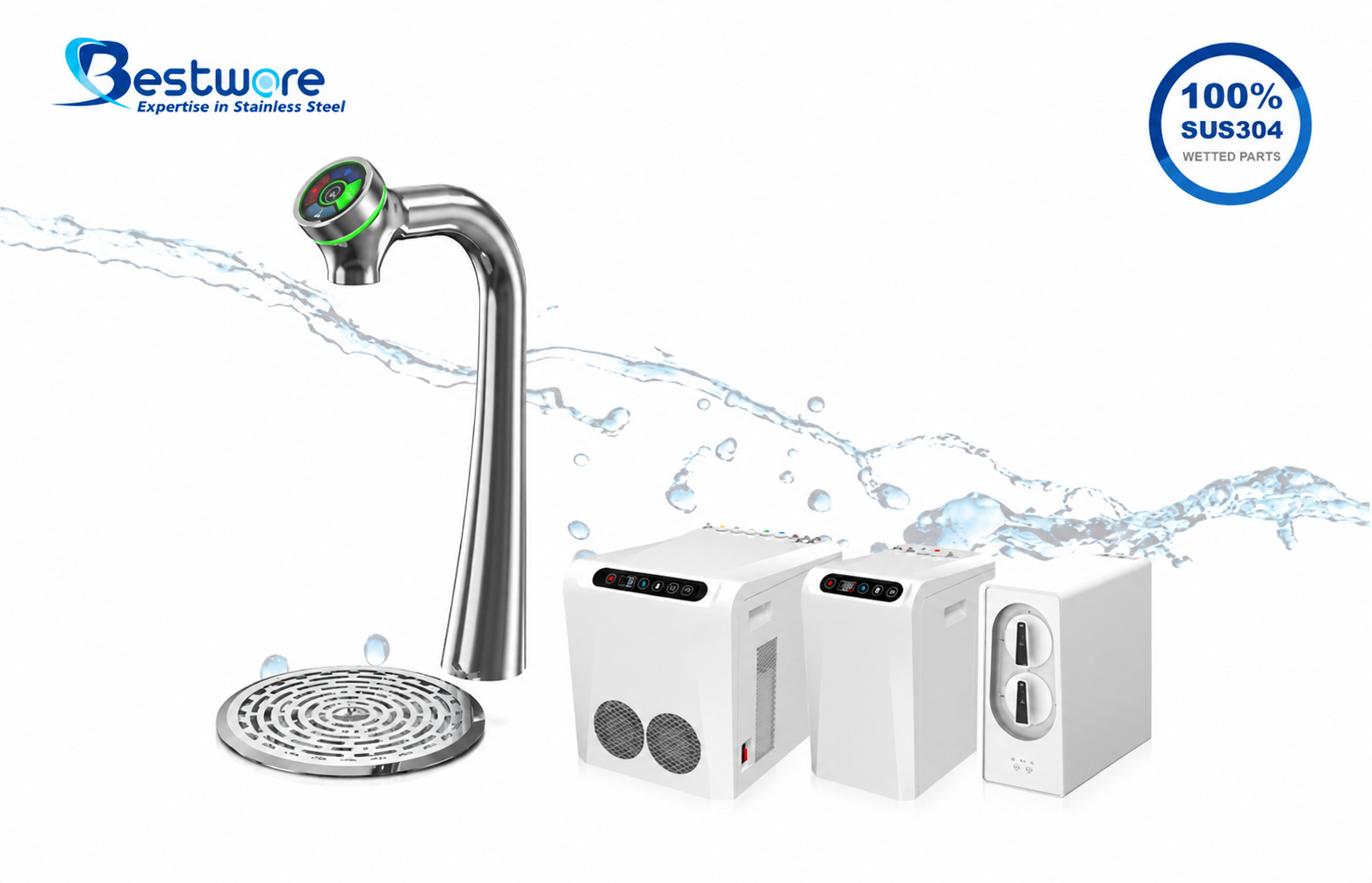
In a system such as Bestware's 4-in-1 solution, the main components are installed under the counter, leaving only a streamlined dispensing tap visible above the worktop.
The tap measures just 158 × 223 × 332 mm and is made from 100% SUS304 stainless steel with a plasma mirror-polished finish.
That means more usable counter space for a coffee machine, snacks, plants — or simply a cleaner, less cluttered environment.
Instead of designing the pantry around the equipment, the equipment works around the space. Pairing the system with a large-capacity CO2 cylinder also reduces the number of small replacement cylinders that need to be stored.
3. Supply Interruptions: Running Out at Exactly the Wrong Time
A typical scenario
During the morning rush, a café needs to prepare drinks continuously.
Pre-chilled water and chilled sparkling water begin running low, so staff have to wait for the next cooling cycle.
Once the water is chilled again, the CO₂ supply may be running low.
At the same time, the hot-water tank or kettle has been emptied, leaving customers waiting while another batch heats up.
And if the ice maker or refrigerator runs out of ice, chilled drinks may slow down as well.
The real problem
When water service depends on several independent appliances, the entire workflow is only as reliable as its weakest link.
Cooling, heating, carbonation, or ice production — if any one of these stops, the overall service process can slow down.
How a commercial 4-in-1 system solves it
With a commercial system like Bestware's 4-in-1 sparkling water dispenser, output reaches up to 40 L per hour, equivalent to approximately 200 servings per hour based on a 200 ml cup.
Maximum flow rate reaches 3 L/min, helping maintain stable dispensing during periods of frequent use.
Hot water | Chilled water | Sparkling water |
5 L | 3 L | 3 L |
Continuous dispensing capacity per cycle
The point of a commercial-grade system is not simply to combine several appliances into one cabinet.
It integrates hot, chilled, ambient, and sparkling water into one coordinated system, reducing the waiting, interruptions, and operational complexity caused by multiple standalone appliances. It can also be paired with a large-capacity CO2 cylinder, extending replacement intervals and reducing the risk of carbonation running out during busy periods.
4. Hidden Labor: When the Admin Team Ends Up Managing the Breakroom
A typical scenario
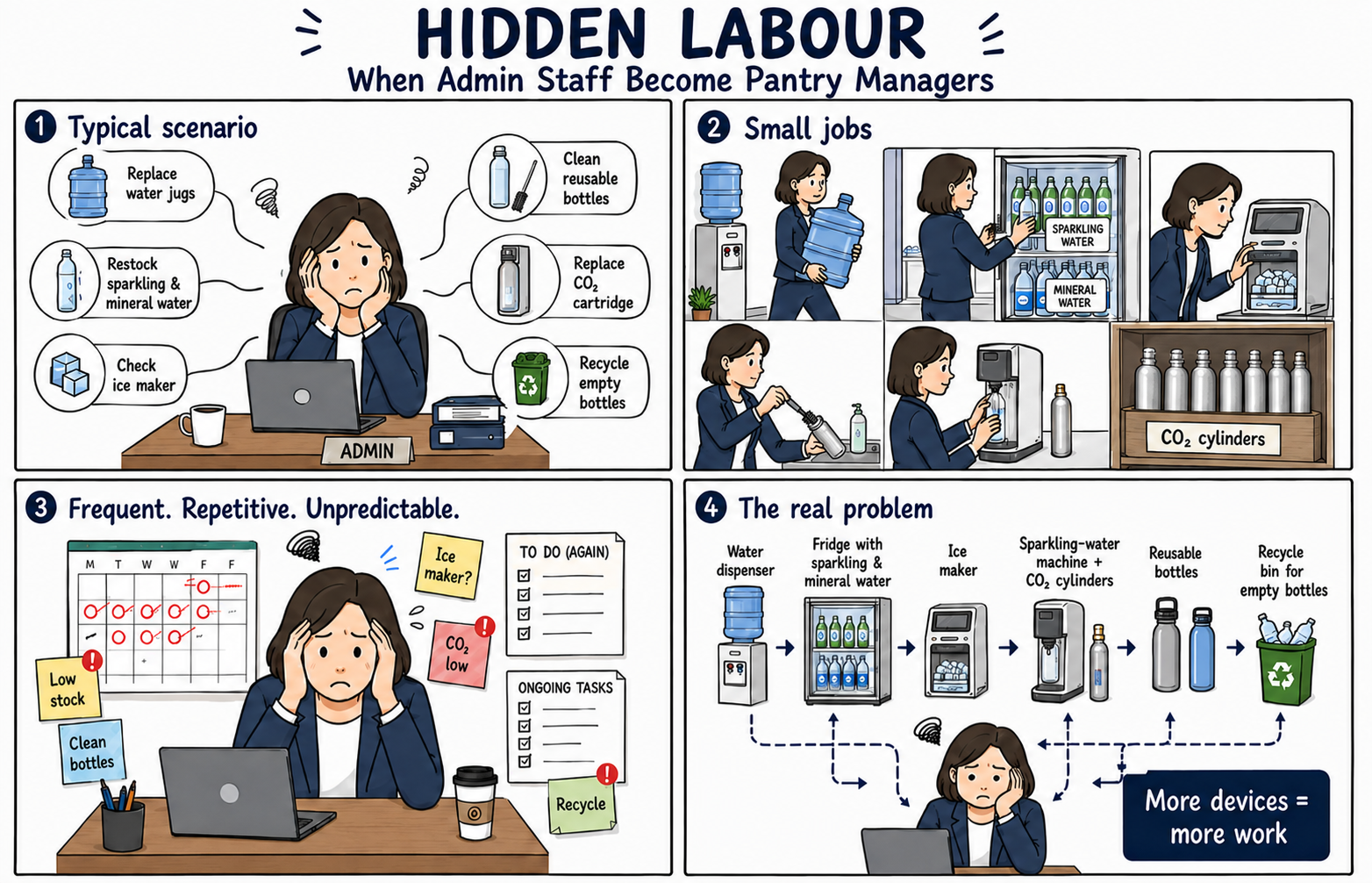
Replacing water jugs. Restocking bottled sparkling and mineral water in the fridge. Checking the ice maker. Cleaning reusable bottles from a household sparkling water machine. Ordering CO₂ cylinders. Replacing filters. Recycling empty bottles.
None of these jobs is particularly difficult.
The problem is that they are frequent, repetitive, and often unpredictable.
Over time, drinking water equipment creates a surprising amount of background work.
The real problem
The management cost of multiple appliances is easy to underestimate.
Every additional device brings another cleaning schedule, refill requirement, maintenance task, or consumable to monitor.
How a commercial 4-in-1 system solves it
Bestware’s 4-in-1 water system consolidates routine maintenance, reducing the need to manage multiple separate appliances.
It can also be connected to a larger-capacity CO₂ cylinder, extending replacement intervals and reducing the frequency of cylinder changes.
With fewer appliances and consumables to manage separately, day-to-day admin becomes simpler and more predictable.
5. Inconsistent Results: When the Same Drink Tastes Different Every Time
A typical scenario
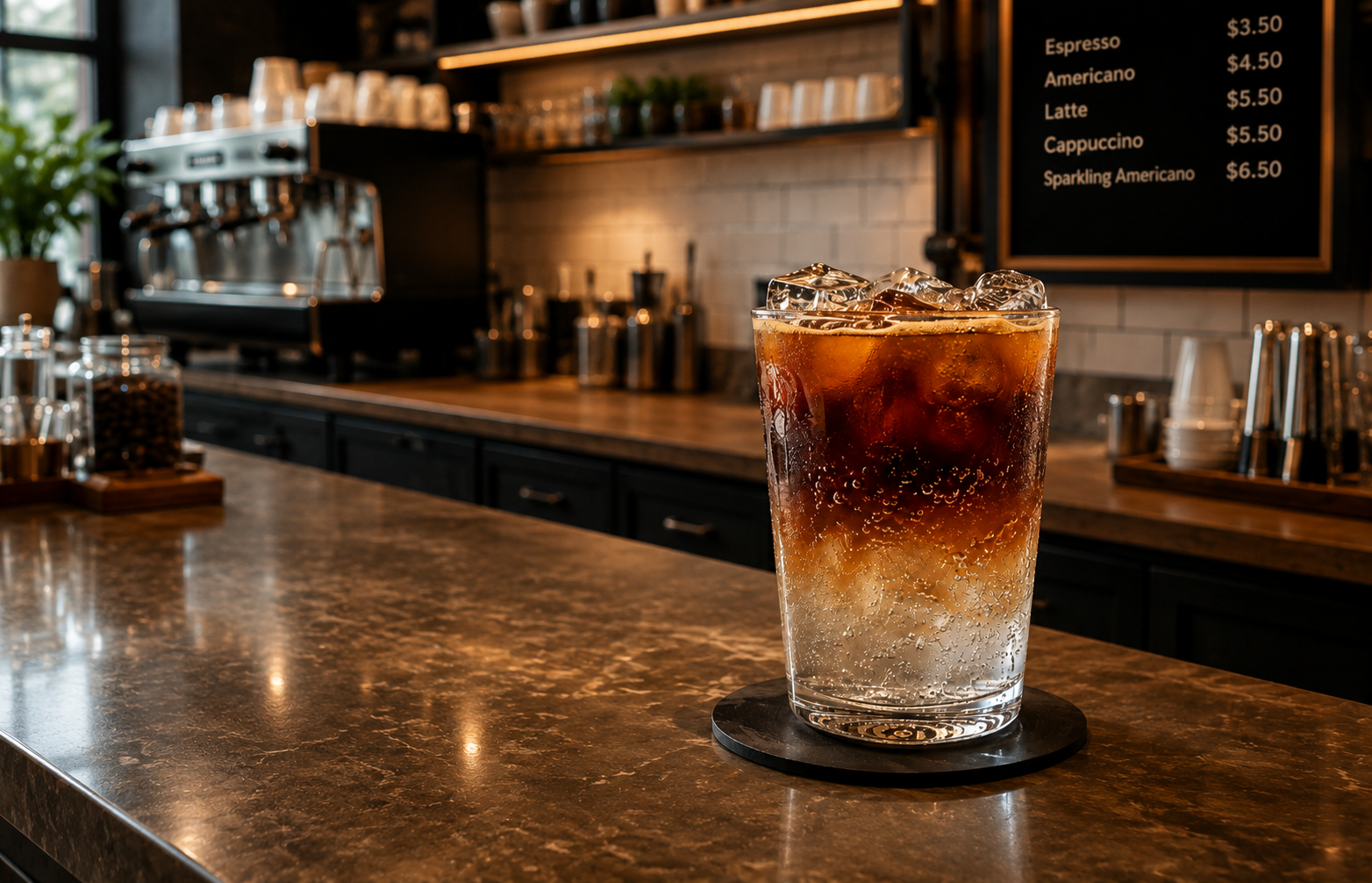
On Monday, a sparkling Americano has a crisp, lively carbonation.
On Wednesday, the same drink tastes noticeably flatter.
The barista has not suddenly forgotten how to make it. The difference may come from the sparkling water itself.
With household carbonation systems, changes in CO₂ cylinder pressure, operating pressure, inlet water temperature, and carbonation time can all affect how much CO₂ is actually dissolved into the water.
The result is variation from one drink to the next.
The real problem
When the outcome depends heavily on manual operation and changing external variables, consistency becomes difficult to control.
For a commercial operation, small variations repeated across hundreds of drinks can gradually affect the customer experience.
How a commercial 4-in-1 system solves it
Bestware's commercial 4-in-1 water system delivers sparkling water at approximately 3.0 volumes of CO₂.
Its gas-liquid mixing system controls key variables such as gas pressure, water temperature, and carbonation time within the same system.
Sparkling water is available at the touch of a button and dispensed chilled, helping provide fresh carbonation on demand with minimal variation from one serving to the next.
Consistency no longer depends on chance. It is controlled by the system.
6. Energy Waste: The Hidden Cost of Running Multiple Appliances
A typical scenario
The water dispenser keeps hot water warm 24 hours a day.
The refrigerator runs continuously.
The ice maker remains powered and ready.
Several pieces of equipment are consuming electricity at the same time, even when demand is low.
Hot-water systems can also release steam into the surrounding area. Over time, excess moisture around the counter or cabinetry may create additional cleaning and maintenance issues.
The real problem
With a fragmented setup, energy consumption adds up across multiple appliances.
And without coordinated energy management, equipment may continue heating, cooling, or remaining on standby even outside peak periods.
How a commercial 4-in-1 system solves it
Taking Bestware’s G1DS-1023 as an example, this model features three energy-management modes — Normal, Heat Retention, and High-Efficiency — helping reduce energy consumption during lower-demand periods.
The G1DS-1023 also features a 100% steam recovery system, which captures steam generated during hot-water production instead of releasing it into the surrounding area, while recovered heat can assist with temperature management.
On-demand chilling helps reduce unnecessary refrigeration, while its water-saving air-cooled technology delivers efficient cooling with lower power requirements.
Instead of relying on several independent appliances, one integrated system allows energy use to be managed more efficiently as a whole.
https://www.bestware-stainless.com/Products/Commercial-Sparkling-Water-Dispensers/4-in-1/G1DS-1023
7. Rethinking Commercial Drinking Water
The difference between a conventional setup and a commercial 4-in-1 system can be summarised simply:
Pain point | Conventional setup | Commercial 4-in-1 approach |
Fragmented functions | Multiple appliances | Four water options from one system |
Space consumption | Cluttered counters | Under-counter installation; only the tap remains visible |
Supply interruptions | Multiple potential bottlenecks | Up to 40 L/h of continuous chilled and sparkling water output |
Hidden labour | Multiple maintenance routines | Consolidated system maintenance |
Inconsistent experience | Variable carbonation | Controlled carbonation at approximately 3.0 volumes of CO2 |
Energy waste | Several appliances operating independently | Steam recovery, on-demand cooling, and three energy-management modes |
The biggest difference is not simply the number of functions. It is the way those functions are managed together.
Conclusion: From Solving Problems to Eliminating Them
The traditional approach to drinking water is simple:
Need chilled water? Add a refrigerator.
Need sparkling water? Add a countertop carbonator.
Need hot water? Add another water dispenser or kettle.
But every appliance added to the space also introduces another potential failure point, another maintenance task, another source of energy consumption, and another piece of equipment taking up space.
A commercial 4-in-1 system takes a different approach.
Instead of adding more equipment to solve more individual needs, it brings multiple drinking water functions into one integrated, intelligent system.
When the pantry stops feeling like an equipment storage room, when administrative staff no longer have to manage several different appliances, and when every glass of water can be delivered quickly and consistently — that is what a modern commercial drinking water system should provide.